
Steady with Ease
Swan River Focus of the Month, November 2026
By: Joy Meade
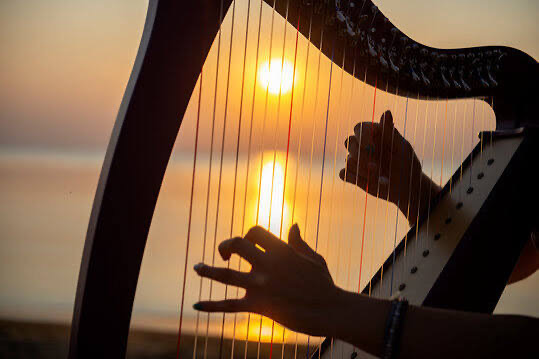
There is a story about an overzealous monk who practiced walking meditation until his feet bled. Discouraged by his injury and lack of progress in his path toward enlightenment, he decided to quit and leave the contemplative life. The Buddha, knowing this monk to be a musician, asked him what happened if he tuned the strings of his sitar too tightly. The monk responded, “they would break, and I wouldn’t be able to play the instrument.” The Buddha then asked him what would happen if the strings were too loose. The monk responded, “The sound would be dull, and there would be no beauty to the sound.” The Buddha then asked what happened when the strings were tuned just right, neither too tightly, nor too loose, and the monk responded, “The strings would be in tune and play in harmony.”
I really sympathize with this monk. Throughout my yoga journey, I’ve often been driven to achieve āsanas (poses) I thought were particularly impressive, pushing myself beyond what I was ready for and then berating myself when I couldn’t do something that seemed to come easily to someone else (when in reality I had no idea what that person’s journey may have entailed). I often observe this habit in my students as well, and with this no-pain-no-gain mindset it becomes easy to overemphasize our āsana practice and lose sight of the underlying teachings that stitch the practice together.
There are thousands of books about yoga, but it may be surprising to find that the most often quoted yoga text, and quite possibly the oldest, does not tell the reader how to align for Virabhadrāsana I (Warrior I), where to place the hands and feet in Trikonāsana (Triangle Pose), or how to stack the joints in any āsana for that matter. The Yoga Sutras, Patanjali’s ancient teachings on yoga, don’t provide alignment cues for the many āsana postures we have come to know and love, but it does offer us the opportunity to explore something far more valuable, a landscape for examining our way of being and mindset. With dedicated application we may even feel ourselves transforming life into a more joyful existence. If that sounds like a lot to expect from a few sun salutations, hear me out.
It is so easy to become preoccupied with what we see. I want to see results, measure outcomes, replicate perfectly whatever it is I am learning. Sometimes I become so wrapped up in achieving my desired results that I become blind to shifts in my attitude, my mindset, and the ripple effect these unseen things have on my environment and the people around me.
Patanjali teaches that the physical exists to mirror the unseen truths we often overlook. Our journey through the Yamas and Niyamas has drawn our awareness to the many external objects, people, and ideas we allow to keep us trapped in a limited experience of this life. After an in-depth exploration of our tendency to look outside ourselves for validation and fulfillment from things that ultimately disappoint us, along with wisdom for transcending this tendency, Patanjali mentions a pose about halfway through the book…sort of.
Sthira sukhamāsanam
Steady easy posture
You can see the word “āsana” couched in there toward the end. The word “āsana” derives from the Sanskrit root “as” which translates to “sit”, “dwell”, or “rest”. The word is generally interpreted as “seat” or “posture,” and in sutra 2.46 Patanjali instructs us to maintain it with both steadiness and ease. This is not always the way I feel when I am practicing handstands or Ardha Chandrasana (half moon), when I often find myself contracting every muscle in my body and holding on for dear life! Patanjali reminds us that the way we sit with life may give excellent insight into the way we tend to move through life. As we bring awareness to our way of being in our seated posture or any āsana we begin to move through life with more awareness and wisdom.
When I was about ten years old, my dad taught me how to ski (shout out to my dad, who turns ninety this month!). He had worked in mountain rescue when he was young, so he had a wealth of experience to draw from. His approach to teaching me was a bit unconventional, and I think that’s what made it so memorable. He skied down the mountain backward while I skied forward, holding onto his arms. He approached this teaching with so much skill, strength, and tenderness.
I learned to keep my knees bent and fluid, knowing that locked knees would almost certainly lead to a tumble. I learned to turn by pressing into one foot and lightening up the other to control my speed as I zig-zagged down the mountain. On gentle slopes, I had the time and space to think through each movement. As the hills grew steeper and bumpier, there was little time to think, but the practice on easier terrain allowed the movements to come more naturally when the path became more challenging.
Our yoga practice is an invitation to bring awareness to the way we live and move through life. Sometimes we charge forward with so much determination, we don’t realize we are driving ourselves and possibly those around us into dis-ease. On the other hand, sometimes we settle in with so little engagement that we miss out on some of the beauty and connection available to us.
In my own yoga practice, I like to explore through a play of opposites. In an āsana that I frequently find myself just sinking into with little engagement, I’ll ask myself, “where could I shine a little brighter without losing the sense of recovery this posture brings. For example, in Malāsana (yogi squat) I will draw up on my pelvic floor and gently press my elbows to my knees and my knees back to my elbows. Nothing incredibly intense, just energy in a posture where I could comfortably let myself sink instead. Conversely in a posture like Utthita Parsvakonāsana (extended side angle), if I find myself squeezing into a version of the posture I can’t maintain for long, or breathing becomes constricted, or everything is shaking, I ask myself if there is anywhere I can stop working so hard without losing the integrity of the shape, anywhere I can soften and make spacious to create some ease in the midst of a challenge.
In any posture I find myself on the mat or off, where could I shine a little brighter, and where could I be a little kinder?
A chant for fostering emotional balance:
Om namashivaya