
Ishvara Pranidhana, Surrender to the Divine
Swan River Focus of the Month, October 2026
By: Kathleen Barry
We’ve arrived at the last of the Niyamas: Ishvara Pranidhana. Ishvara Pranidhana can be described as surrender to something greater than the individual Self. But rather than a grandiose concept of complete, passive surrender of one’s will, Ishvara Pranidhana invites curiosity, skillful action, and choice.
As with each of the preceding Yamas and Niyamas, Ishvara Pranidhana invites us to skillfully meet life on life’s terms. Specifically, this Niyama encourages us to notice where we pay our attention, which is the currency of our life force (prana). This can show us with clarity, fluidity, and trust what life is asking of us, in each moment.
Arguably, surrender can be one of the most challenging concepts for the human ego to grasp. We are taught to be action oriented, strategic, and linear in our thinking. Paradoxically, surrender is a chance to sincerely practice meeting the moment with both truth and ease. Deborah Adele says in Yamas and Niyamas:
It is as if we are partnered to life in a dance step. We do not lead, nor do we limply drag along like dead weight. As a dance partner to life, we are asked to be vulnerable and undefended, and yet so present we can follow the next move, wherever the leading step takes us, adding our own style as we go. (p. 171)
So, how do we make surrender an active practice?
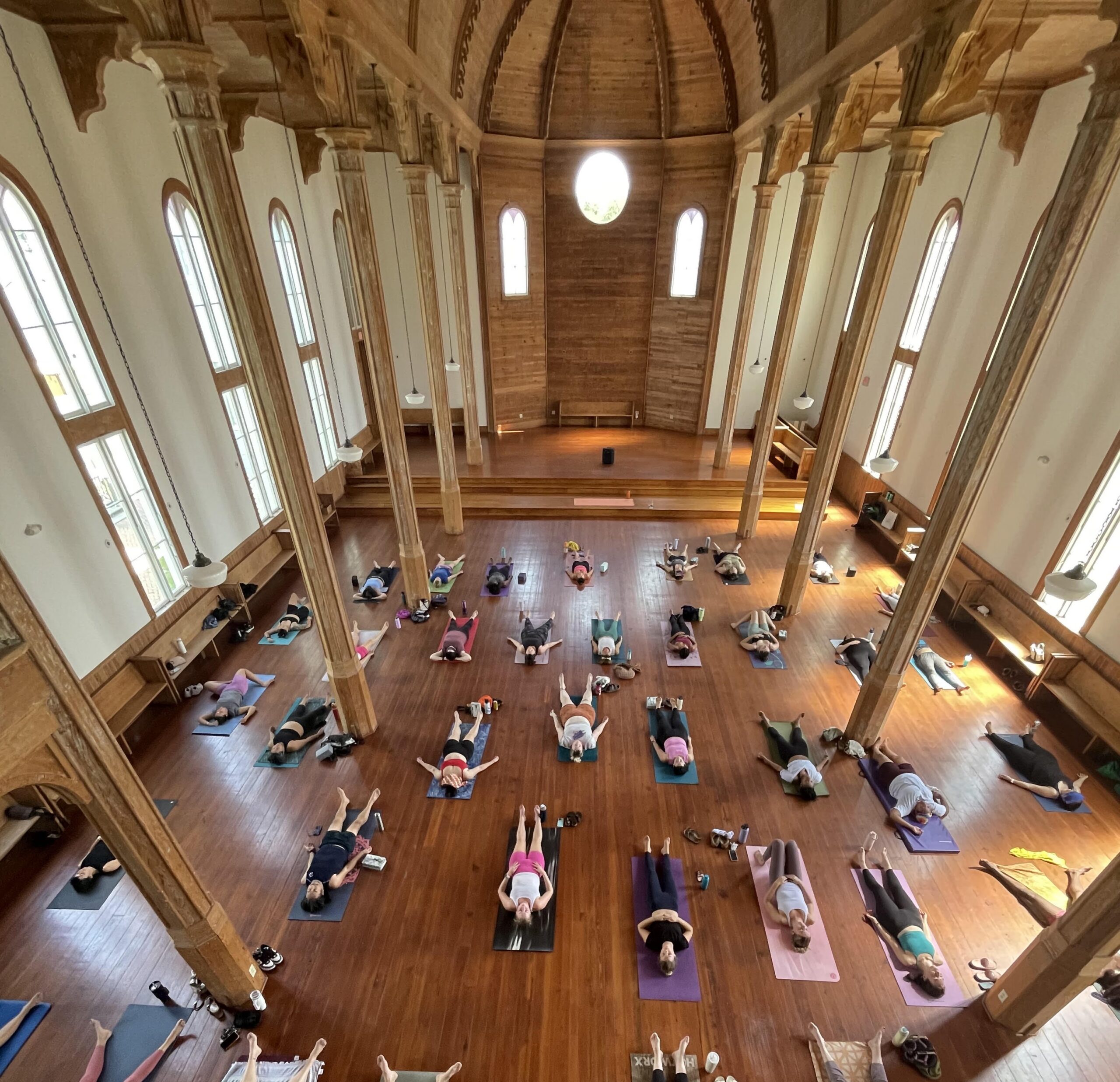
To use a practical example, savasana is a form of Isvara Pranidhana. Yoga classes end with usually 3-10 minutes to be silent, receptive, and reclined. This very “passive” pose can actually be where many folks truly struggle. Some even skip this essential part of the yoga practice, each with their own reason. Some may feel it’s unnecessary, especially as Western yoga has become predominantly a fitness modality rather than a more holistic mind, body, and spirit practice. Others feel it’s too hard to “relax”, or that life is too busy for savasana.
For me, savasana is a chance to put the ego’s mask down. For several minutes, I get to be no one. Some days, it’s very challenging to quiet the spinning mind. A very human response! Yet, other days, when surrender is more accessible as a practice, savasana can be a major relief and reset for my mind, body, and spirit. And, science is proving this beyond just our lived experience as yogis.
To practice savasana is to choose, for those maybe 5 minutes or less, to de-identify with the chitta vritti (spinning mind-stuff) to simply be, receive, and do nothing. Once again, yoga practice offers us a non-dual approach: surrender to the Divine is to be nobody, go nowhere, do nothing and watch what arises. What if it could be compassion and acceptance? This is an active choice. And thus, we become skillful through dedicated, sincere practice of that choice.
True surrender is acknowledgement of both our impermanent parts (body, ego) as well as our infinite Divinity (spirit, soul, atman). The most enduring part of us cannot be fully described with words. Read any of the yogic texts, from the Sutras to the Vedas, and it becomes clear: since the beginning of time, humans have asked “Who am I?” Yoga invites the question, “Who’s the ‘who’ observing the question being asked?”
The quiet, still part that lives within each of us requires devoted attention. My teacher Janet speaks beautifully on cultivating the kind of devotion to attention that allows real surrender on a recent Substack post:
What matters to me? What am I moving toward? And do the choices I am making, again and again, lead me in that direction? This, to me, is where devotion begins. Not as a grand declaration. Not as a personality trait. Not as something reserved for saints, mystics, or people who own more linen clothing than I do. But as a practice of attention. Because our attention is constantly shaping us.
To let go of the individual Self stories – the stories of ego, identity – is no easy feat. As a human being, I constantly worry I’ll fall behind, get left out, say the wrong thing, or offend someone. Yoga tells us that this is a very contractive way to live. Ishvara Pranidhana, with its emphasis on Divinity – whether that’s God, grace, or some other form – invites expansion. The ability to zoom out on my life and identity, to remember I’m a tiny drop within the vast ocean of existence. And yet again, paradoxically, the entire universe lives within me.
Other practices:
Yoga nidra is another beautiful, surrender-based practice that, with practice, can significantly improve brain health. Tracee Stanley, author of Radiant Rest, has incredible resources like this yoga nidra video on YouTube.